

Building industrial infrastructure in orbit requires solving a set of engineering challenges that extend beyond launching equipment into space. Temperature regulation, power management, vibration protection, payload integration and safe return capabilities all become critical when industrial processes must operate in microgravity. Space Cargo Unlimited is addressing these requirements through REV1, a reusable spacecraft designed to function as an integrated platform for commercial research and manufacturing.
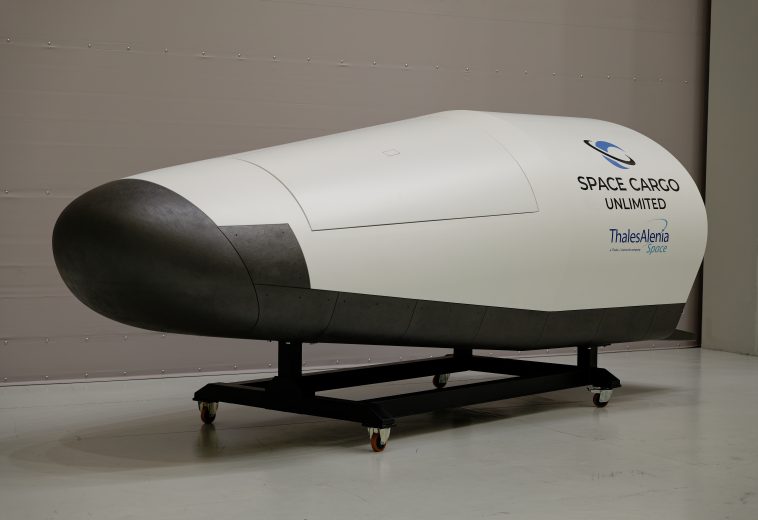
The company unveiled a full-scale development model of REV1 at Space Tech Expo Europe in Bremen, Germany. Privately funded by Space Cargo Unlimited and co-developed with Thales Alenia Space, the spacecraft is targeting flight readiness in 2030, subject to development and qualification milestones.
At the center of its architecture is BentoBox, a standardized, modular platform designed to integrate customer equipment and manage in-orbit operations. Rather than developing a spacecraft around a fixed set of payloads, Space Cargo Unlimited is building an architecture that can accommodate different industrial instruments, processes and operational requirements.
The REV1 development model is already supporting engineering work on the spacecraft’s active thermal systems. Manufacturing is also underway on the mechanisms that will integrate BentoBox into the vehicle’s structure, advancing the technical interfaces between the modular platform and the spacecraft.
BentoBox is being developed with a range of environmental and operational controls. These include controlled pressurization, temperature set-point management, thermal and cooling-loop control, and power distribution and sequencing. Together, these systems are intended to provide a controlled environment for equipment that must operate under specific conditions in microgravity.
The platform also incorporates technologies designed to address payload handling and data management. Late-access capabilities will allow customers to load time-sensitive materials, including biological samples, closer to launch. Vibration and load mitigation systems are intended to protect sensitive equipment during launch and re-entry.
Once operational, BentoBox is expected to provide continuous monitoring, data logging and real-time sensor feedback. These capabilities could give customers greater visibility into experimental conditions and help them adjust processes while operating in orbit. Space Cargo Unlimited is also developing onboard autonomy and edge-computing capabilities to optimize industrial workflows without depending entirely on ground-based intervention.
For applications involving pharmaceuticals and biotechnology, the company is working on certified biological payload pathways and chain-of-custody processes. These features are particularly relevant to regulated industries in which sample integrity, traceability and controlled handling are essential.
REV1 is designed to extend the platform’s capabilities through a reusable, two-module architecture. Its specifications include tonne-class payload capacity, 1,200 liters of pressurized internal volume and 2.5 kW of shared continuous power. The spacecraft is being developed to support missions lasting from several weeks to up to six months, depending on the application.
The Orbital Module will supply power and operational services during the mission, while the Re-entry Module will transport payloads back to Earth for retrieval, refurbishment and potential reuse. This separation of orbital operations and payload return is central to the spacecraft’s design, allowing industrial equipment and materials to be recovered after completing their work in microgravity.
Nicolas Gaume, co-founder and CEO of Space Cargo Unlimited, said the engineering approach is based on building the spacecraft around the technical requirements of its customers.
“We have always believed that microgravity can become a new environment for industry, but that potential depends on building the right infrastructure. With BentoBox, we are developing the space factory that can fly across a fleet of vehicles. REV1 is being designed from the inside out to take this BentoBox capability even further, around the equipment and processes our customers need,” Gaume said.
Thales Alenia Space is contributing its engineering capabilities to the spacecraft’s development, particularly in areas involving thermal systems, structural integration and re-entry technologies. Roberto Angelini, vice president of Exploration and Science at Thales Alenia Space, highlighted the work already underway on the development model.
“The current development module is already helping the evolution of the active thermal systems of the vehicle, while proceeding with the manufacturing of the mechanisms to integrate Space Cargo Unlimited’s BentoBox inside its structure,” Angelini said.
Before REV1 becomes operational, Space Cargo Unlimited plans to test BentoBox through missions aboard partner spacecraft. The roadmap includes a flight on ATMOS Phoenix 2.1 in 2027 and a one-tonne mission aboard SpaceX’s Starfall re-entry vehicle, scheduled for no earlier than 2028.
These missions will help validate interfaces, test platform capabilities and establish operational procedures that can eventually be transferred to REV1. They are also part of a broader strategy to make BentoBox compatible with multiple vehicles, creating a modular technology platform that can operate across a fleet.
Space Cargo Unlimited is already discussing potential applications with more than 150 customers and prospects across pharmaceuticals, biotechnology, advanced materials and semiconductors. Approximately 40% of those discussions involve companies in life sciences and biotechnology.
With REV1, the company is combining spacecraft engineering, modular payload integration, environmental control systems and reusable re-entry technology into a single architecture. Its technical challenge now is to qualify these interconnected systems and demonstrate that they can support repeatable industrial operations in microgravity, with flight readiness targeted for 2030.










 17 c
 16 c