By Pablo Miller, co-founder and CEO of Remoti
Technical expertise has been the key currency of a global career for many years. Companies have been hiring people based on what you could build, code, and analyze. Now, with AI, all this is changing not by rendering technical skills irrelevant, but by increasing the bar for every other one.
According to the World Economic Forum’s Future of Jobs Report 2025, the two fastest-growing skill sets are artificial intelligence and big data; however, creative thinking, resilience, adaptability, and curiosity are also on that list.
The professionals who are getting ahead in their respective fields are not the ones who know most about a particular technological tool; rather, they are those who can exercise judgment, communicate across complex environments, and adapt as the tools themselves keep changing. Microsoft’s Work Trend Index identifies AI literacy as the most in-demand skill of 2025, with human strengths like adaptability, conflict mitigation, and innovative thinking rising in parallel, because the future belongs to those who can pair AI capabilities with what machines still cannot replicate.
This is not a minor recalibration. It is a redefinition of what career value means.
What employers are competing to hire.
However, as stated in the WEF report, displacement is never equal to vanishing; there will be many cases where jobs will change rather than being replaced, as humans do the jobs that require critical thinking and creativity, whereas AI takes care of the rest. Thus, what emerges from all this is that the bar has been raised for all; technically skilled people need to understand and interact with others from diverse backgrounds and expertise.
Out of the total 2,800 skills analyzed in WEF, none were rated as having high potential for being replaced by AI systems available now. The majority (69%) showed very low or low substitution potential, with skills rooted in human interaction, nuanced judgment, and hands-on application currently showing no substitution risk at all. The implication for professionals is direct: depth in human skills is not a soft hedge against automation. It is increasingly the core of what employers are competing to hire.
Why Latin America is uniquely positioned
This shift carries particular implications for Latin America. The region’s workforce has long navigated complexity, economic volatility, multilingual environments, and the demands of working across cultures, and those conditions produce exactly the adaptive, resilient professionals that AI-era organizations are now seeking.
In Latin America, there has been a rise of 161% in US companies’ hiring of remote workers from 2023 to 2025, which is followed by even greater adoption of remote working in 2026 due to not only economic reasons but also because of high-quality and diversity of available talent. In accordance with estimates of McKinsey and the World Economic Forum, annual productivity gains in Latin America from AI implementation may be from 1.9 to 2.3%, amounting to a $1.1-$1.7 trillion increase in GDP but only if gaps in infrastructure and skills are filled.
That is the critical condition. The opportunity is real. So is the work required to realize it.
Why Companies Must Rethink Talent Development
The organizations gaining the most from AI are not those that deployed it fastest. Analysis from the WEF suggests AI will create more jobs than it displaces, but only if companies invest deliberately in people and redesign work, rather than simply layering technology onto old structures. Hiring alone is not enough. If professionals cannot grow inside an organization, if there is no structure for career progression, skills development, or meaningful advancement, they leave. And replacing them costs more than retaining them ever would.
The Microsoft Work Trend Index found that 82% of leaders describe this as a pivotal year to rethink core aspects of strategy and operations — with those who pair irreplaceable human insight with AI unlocking outsized value compared to those treating AI as a standalone efficiency tool. The distinguishing factor between those two groups is not the technology they use. It is whether they have built the organizational conditions for people to develop alongside it.
The Infrastructure Question
This is where workforce infrastructure becomes a strategic variable rather than an HR function. Companies building distributed teams across borders — particularly in regions like Latin America — face a practical challenge: the compliance, payroll, onboarding, and operational systems required to support international talent are complex to build from scratch, and most organizations are not in the business of building them. The firms that solve for this most efficiently are those that treat the operating model itself as part of the talent proposition, creating conditions where professionals can access global careers, build meaningful skills, and remain where they are.
This is the operating logic behind Workforce-as-a-Service models, which have gained traction precisely because they address this gap. Rather than a staffing layer, a well-designed WaaS model provides integrated workforce infrastructure — recruitment, onboarding, compliance, payroll, local support, and the career development pathways that determine whether a hire stays or leaves. The distinction matters: filling a seat and building a career path are not the same thing, and the organizations that treat them as equivalent tend to experience the retention problems that make global hiring feel more expensive than it should be.
The Differentiator was never the tool
The careers that endure in the AI era will belong to professionals who learn continuously, collaborate across boundaries, and bring the kind of contextual judgment that no model yet produces reliably. The companies that build the infrastructure to support those professionals, rather than simply deploying them, will find themselves with a structural advantage that compounds over time.

In a market where the tools are increasingly available to everyone, the differentiator will be the people who know how to use them well, and the organizations that gave them the conditions to grow.
Pablo Miller is the co-founder and CEO of Remoti, a Workforce-as-a-Service and talent infrastructure platform that helps global organizations recruit, hire and manage distributed teams across Latin America.
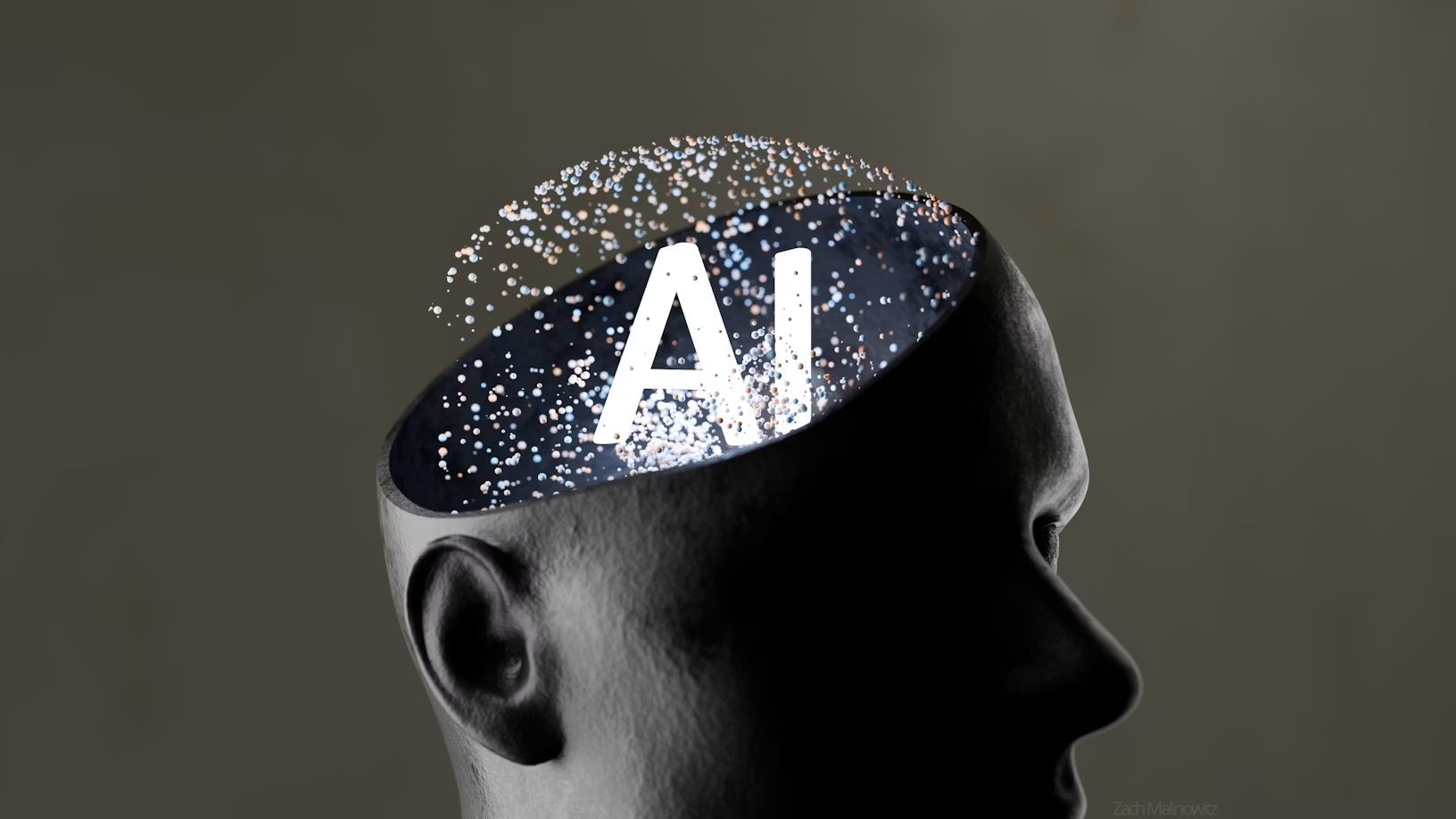
Featured image: Zach M via Unsplash+
Disclosure: This article mentions a client of an Espacio portfolio company.